Many students don't know where to start
They don't know which careers to search for or what questions to ask. It's hard to look for a career you've never heard of.
Career and pathway discovery for high schools
Campus Match is a guided career discovery process for high schools. Through conversation, students move from uncertainty to several concrete career directions, connected to the majors, training, and pathways that lead there. Counselors gain useful context about each student's interests, exploration, and emerging direction.
The problem
They don't know which careers to search for or what questions to ask. It's hard to look for a career you've never heard of.
Surveys, forms, filters, and lists work best for students who already have some direction.
Large caseloads make extended one-on-one career discovery hard to offer to every student.
Every student deserves a chance to explore before they're expected to decide.
Intended outcomes
Campus Match helps schools give more students an individualized career discovery experience, while giving counselors visibility into each student's interests, career exploration, and emerging direction.
How it works
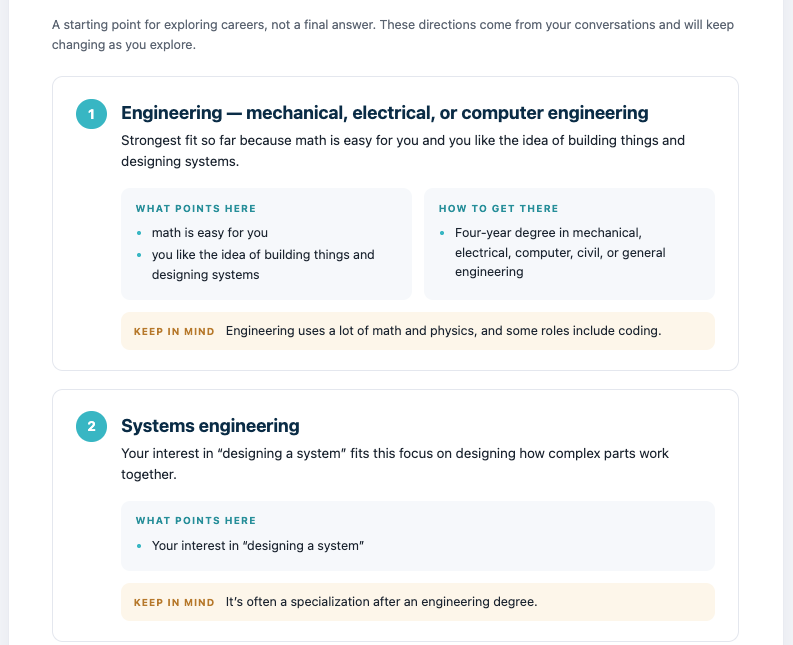
Students don't need to know which careers to search for or what terms to use. They can follow their interests while Campus Match provides the structure and keeps discovery moving toward useful career directions.
Students talk naturally about their interests, strengths, preferences, and dislikes.
Campus Match builds an evolving picture of the student and introduces career possibilities.
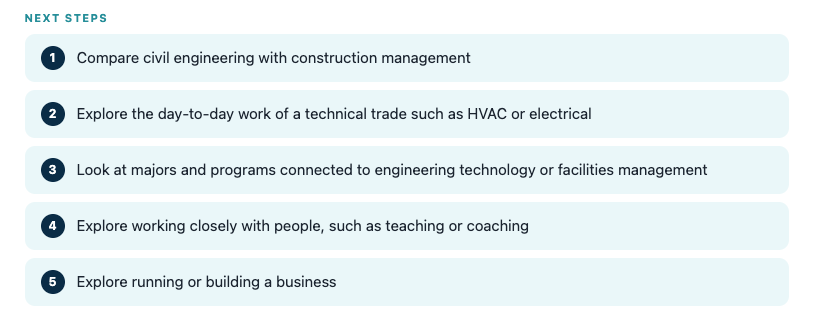
Students react to careers, compare options, reject poor fits, and refine their direction.
Promising careers connect to majors, colleges, certifications, training, trades, and other pathways.
For counselors
The counselor dashboard shows each student's interests and preferences, the careers they considered, liked, or rejected, and the pathways they're weighing, even when one-on-one counselor time is limited.
Interest evidence is organized using the well-established RIASEC (Holland Code) framework.
More for counselorsWhy Campus Match
Students don't need to know what career to search for before they begin.
Students explore through dialogue instead of completing a long questionnaire and receiving a report.
Students can react to careers, reject them, compare them, and refine their direction.
Career exploration connects to majors, colleges, certifications, training, trades, and other pathways.
More students receive individualized career exploration, even when counselor time is limited.
Theory of change
What we're measuring
We're beginning to measure whether Campus Match helps students reach clearer career directions and gives schools more useful visibility into the discovery process. Measurement starts with our Pennsylvania high school pilot and looks at:
Pilot underway
Campus Match is now being introduced in a Pennsylvania high school pilot. It can be introduced through a counselor-led lesson of about 45 minutes, with simple slides and student access. No curriculum overhaul or long technical rollout.
It's one way to begin, not the only one. We'll work with you on what fits your school.
A counselor-led introductory lesson.
A simple plan counselors can follow.
Ready to use in the classroom.
Students start exploring; counselors see their progress.
Trust and safety
Campus Match is built specifically for high school students and the schools that serve them.
Campus Match supports counselors. It does not replace them.
Student conversations can be evaluated for serious safety concerns by a system separate from the guidance conversation.
Authorized school personnel can review escalated situations.
Once a situation is escalated, the system can't clear it on its own.
Student information is handled with care. We're glad to walk through how it's stored and who can see it.
Request a demo
We'll walk through the student experience, the counselor dashboard, and what a first class period could look like at your school.